From Aztlan to Tenochtitlan: The Rise of the Mexica
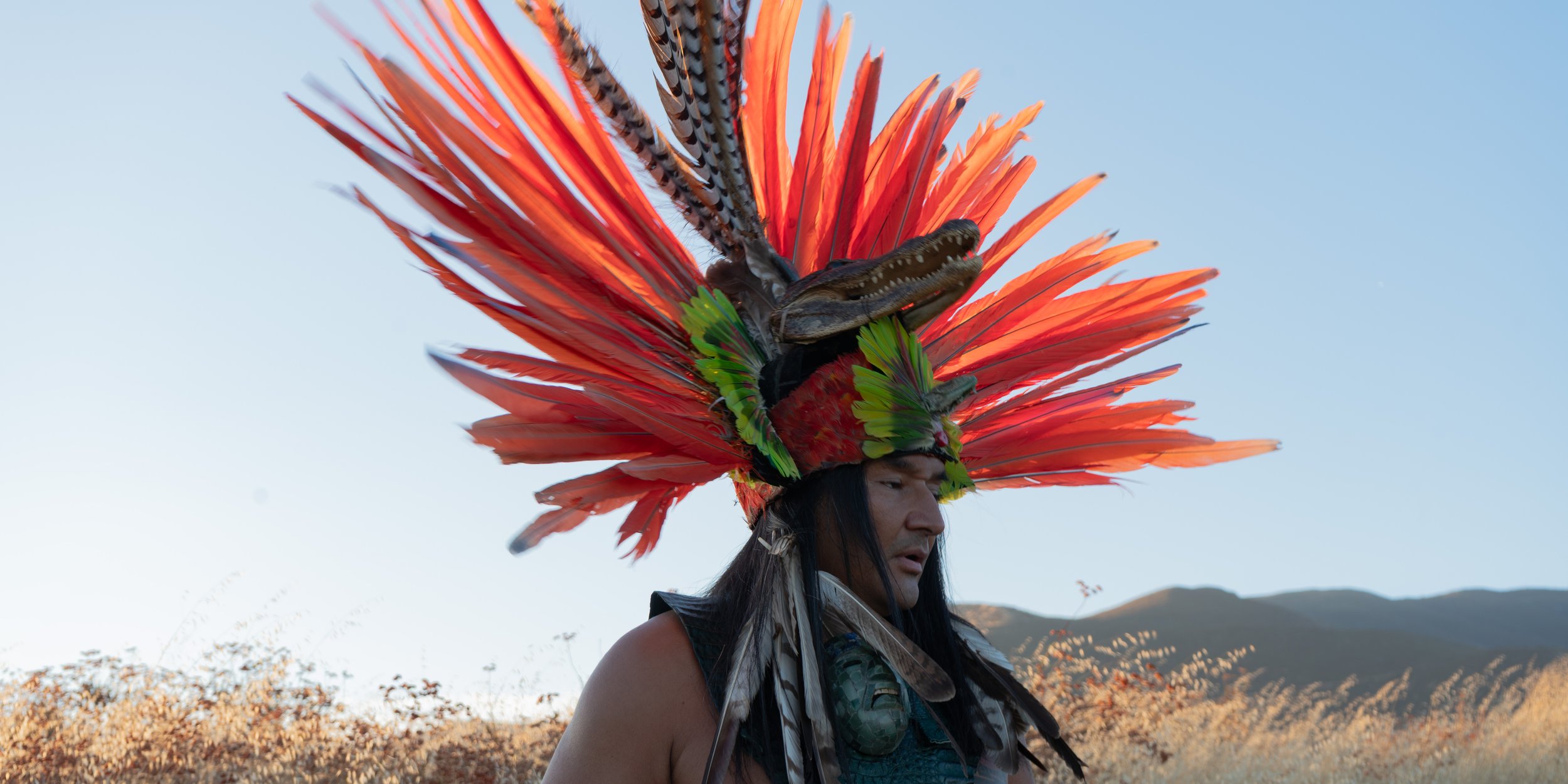
The Aztec-Mexica people were a Nahuatl-speaking group who migrated from a legendary northern homeland called Aztlan into central Mexico during the 12th and 13th centuries.
After years of wandering and serving as mercenaries for more powerful city-states, they settled on an island in Lake Texcoco in 1325, where they founded Tenochtitlan after witnessing the prophesied sign of an eagle perched on a cactus. This image later became the symbol of modern Mexico.
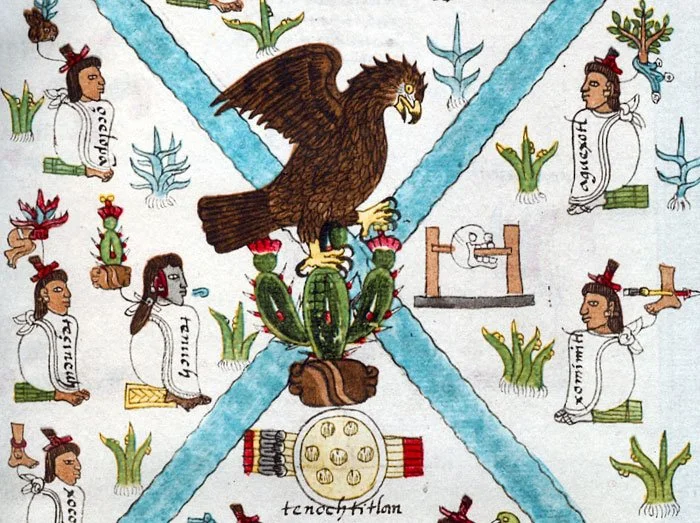
The term “Aztec” comes from this ancestral place and broadly describes the various peoples connected to that migration tradition, while “Mexica” specifically refers to the group that founded Tenochtitlan, the capital of the Aztec Empire. The name “Mexico” itself is derived from “Mexica,” reflecting their lasting cultural and historical influence on the region.
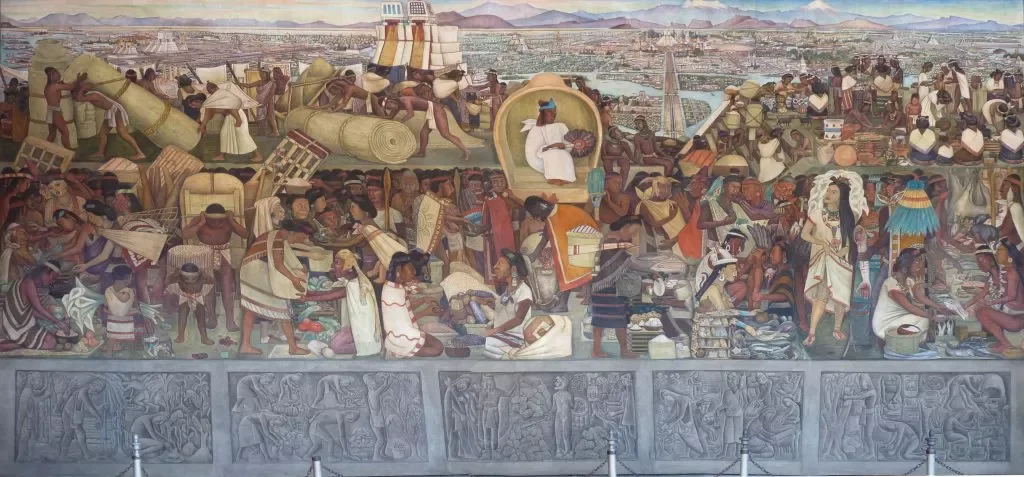
Over the next two centuries, the Mexica transformed Tenochtitlan into one of the largest and most sophisticated cities in the world. Through warfare, political alliances, tribute systems, and religious authority, they formed the Aztec Empire alongside the cities of Texcoco and Tlacopan in the Triple Alliance. Their civilization became known for monumental architecture, advanced agriculture such as chinampas, elaborate religious rituals, military organization, poetry, astronomy, and rich artistic traditions.
Architecture
The Mexica expressed their power and cosmology through monumental architecture, constructing massive temples, pyramids, palaces, and ceremonial plazas throughout Tenochtitlan. At the center stood the Templo Mayor, a towering dual temple dedicated to the gods Huitzilopochtli and Tlaloc, symbolizing war, fertility, and cosmic balance. Their architecture transformed the city into both a political capital and a sacred reflection of the universe.
Advanced Agriculture
To sustain their growing population, the Mexica developed advanced agricultural systems known as chinampas, or “floating gardens,” built within the shallow waters of Lake Texcoco. These fertile artificial islands allowed for continuous cultivation of maize, beans, squash, flowers, and other crops, making Tenochtitlan one of the most productive urban centers of the ancient world. This innovation reflected the Mexica ability to harmonize engineering with the natural environment.
Religious Rituals
Religion shaped every aspect of Mexica life, and elaborate rituals were performed to maintain balance between humanity and the cosmos. Ceremonies included offerings, music, dance, processions, and human sacrifice, which the Mexica believed nourished the gods and sustained the movement of the sun and universe. These sacred practices reinforced their cosmology, where life, death, and renewal existed in constant motion.
Dance and Sacred Movement
Dance was an essential expression of Mexica identity, serving as a bridge between the human and divine worlds. Performed during religious festivals, military celebrations, and seasonal ceremonies, dances combined rhythmic movement with music, poetry, and elaborate costumes to honor the gods and reinforce communal values. Young people were trained in these traditions through institutions such as the cuicacalli (“house of song”), where they learned sacred songs, choreography, and ritual discipline. Azteca dance embodied the principle of ollin (movement) which allowed the dancers to maintain harmony between society, nature, and the cosmos.
Military Organization
The Mexica built a highly organized military society in which warfare served political, economic, and spiritual purposes. Young men were trained from childhood in discipline, endurance, and combat through schools such as the telpochcalli. Military achievement offered social advancement, while elite warrior orders, including Eagle and Jaguar warriors, became symbols of honor, power, and sacred duty within the empire.
Poetry
Poetry held a sacred place in Mexica culture and was often described through the phrase in xochitl in cuicatl — “flower and song.” Poems explored themes of beauty, warfare, mortality, friendship, and the divine, reflecting a civilization deeply aware of life’s impermanence. These compositions were performed with music and dance, preserving history, philosophy, and spiritual knowledge through oral tradition.
Astronomy
The Mexica closely observed the movements of the sun, moon, stars, and planets, integrating astronomy into religion, agriculture, and governance. Their calendar systems tracked sacred rituals and seasonal cycles with remarkable precision, helping determine ceremonies, warfare, and planting seasons. Celestial movement was understood as part of a living cosmos, reinforcing the belief that human actions were connected to the order of the universe.
Artistic Traditions
Mexica artistic traditions flourished through sculpture, featherwork, ceramics, goldsmithing, weaving, and painted codices. Artists created works that blended natural imagery with sacred symbolism, transforming materials such as jade, turquoise, obsidian, and quetzal feathers into objects of spiritual and political meaning. Their art was not only decorative but cosmological, designed to express divine power, identity, and the structure of the universe itself.


Look sharp, move well, stay cool. The Ollin Button Down is inspired by the Mexican guayabera and cut like a classic oxford shirt.